
Texting Clients Without Handing Out Your Personal Number
Texting is the only channel people still read within five minutes. Most small businesses do it from somebody's personal mobile, which puts the whole conversation in one pocket.
Texting is the only channel your clients still read within five minutes. Email gets triaged. Social gets scrolled. A text gets looked at, almost every time, almost immediately.
Which is why so many small businesses end up doing it from somebody's personal mobile. It works, right up until the moment it does not.
What a personal phone costs you
The conversation lives on one device, in one person's pocket. Nobody else can see what was agreed. When that person is off, the thread is unreachable, and when they leave, it goes with them.
There is no record against the client. Six months later, when somebody insists they were told the appointment was Thursday, the evidence is in a phone that has since been wiped.
And it costs the person their evenings, because a number that clients have is a number clients use at nine at night.
One inbox, both channels
In ClientBranch, texts and emails land in the same place. Conversations is one list, with a badge on each thread telling you which is which.
That sounds like a small convenience and it changes the day more than you expect. There is no app switching, and no moment of wondering where a particular exchange happened. If you have spoken to somebody, it is in that list.
The thread is the record
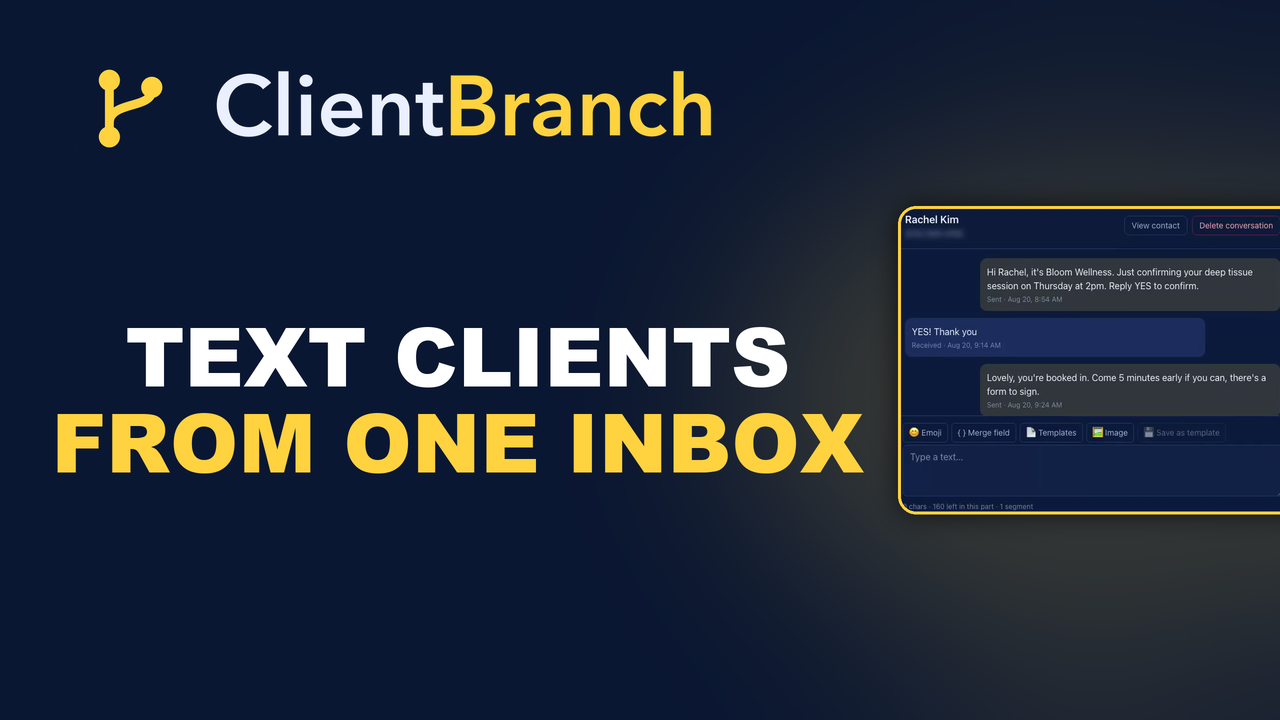
Open a text conversation and you see the whole thing. What you sent, what they sent back, in order, kept against their contact record.
Anybody on your team can pick it up and see exactly what was said. That is the part a personal phone can never give you, and it is the reason to move even if nothing else here appeals.
Writing a text that does not read like a robot
Merge fields drop the person's real first name in as the message goes out. So a text to forty people still reads like a text to one, which is the whole difference between a message that gets a reply and one that gets ignored.
There is an emoji picker, saved templates for the messages you send constantly, and image attachments if you need to send a photo.
The counter under the box
This is the bit worth understanding before your first big send, because it is where the money goes.
A plain text gives you 160 characters per segment, and each segment is what you are charged for. Go over and it splits into two, and you pay for two.
Add a single emoji and the whole message switches to Unicode, which drops you to 70 characters a part. One friendly smiley face can quietly double the cost of a large send. The counter tells you before you press the button, which is the only sensible time to find out.
Give people a way out
Every marketing text needs an opt-out line. Reply STOP, and mean it.
This is not optional politeness, it is how texting stays legal, and it is also self-interested. A list of people who have chosen not to leave is worth far more than a list of people who cannot.
Where the number comes from
You rent a number for the business under Settings, then Phone. A few dollars a month, and it belongs to the business rather than to a person.
In the United States a toll-free number has to be verified before the carriers will let it run at full speed. That verification is a form you fill in on that screen. Until it clears, texts still go, they just go slowly, and it is worth starting the process the day you get the number rather than the week you need to send something.
What it costs to run
Texts are charged by use and come out of a prepaid wallet rather than off your card each time. Two cents a segment, five for a picture message. Receiving anything is included, and so is all of your email.
The wallet can reload itself when it runs low, which matters more than it sounds: a reminder that fails to send because a balance hit zero is the one message you needed most.
Replies come back to the team, not to a person
When somebody replies to your business number, it lands in the shared inbox and anybody with access can pick it up. That is the difference between a channel your business runs and a channel one employee runs on your behalf.
It also means a reply never sits unread because the one person who owns the phone is on vacation, which is the failure mode that costs bookings.
What to use it for
Reminders, first. A text the day before an appointment cuts no-shows more reliably than anything else you can do for two cents.
Then the short logistical things that email is too slow and too formal for. Running ten minutes late. Parking is round the back. Your slot is confirmed.
Leave the long stuff to email. A text that has to be scrolled has failed.
And resist the urge to use it for marketing more than occasionally. The reason texts get read is that they are rare and relevant. Spend that down and you have trained people to ignore the one channel that was working.
The version that scales
One number for the business, one thread per client, and everything your team said in a place they can all see.
It is the same channel your clients already prefer, without the part where it all depends on one person's phone.
Moving is not a project either. Rent the number, start the verification, and use it for appointment reminders first. That single use case usually pays for the number several times over in the first month, and it gives your clients a reason to save the new one.
Start your free trial and get your business its own number.
Try ClientBranch free for 15 days
Get booked, get paid, and keep clients coming back, all from one place. No card required, cancel anytime.
Start my 15-day free trial